
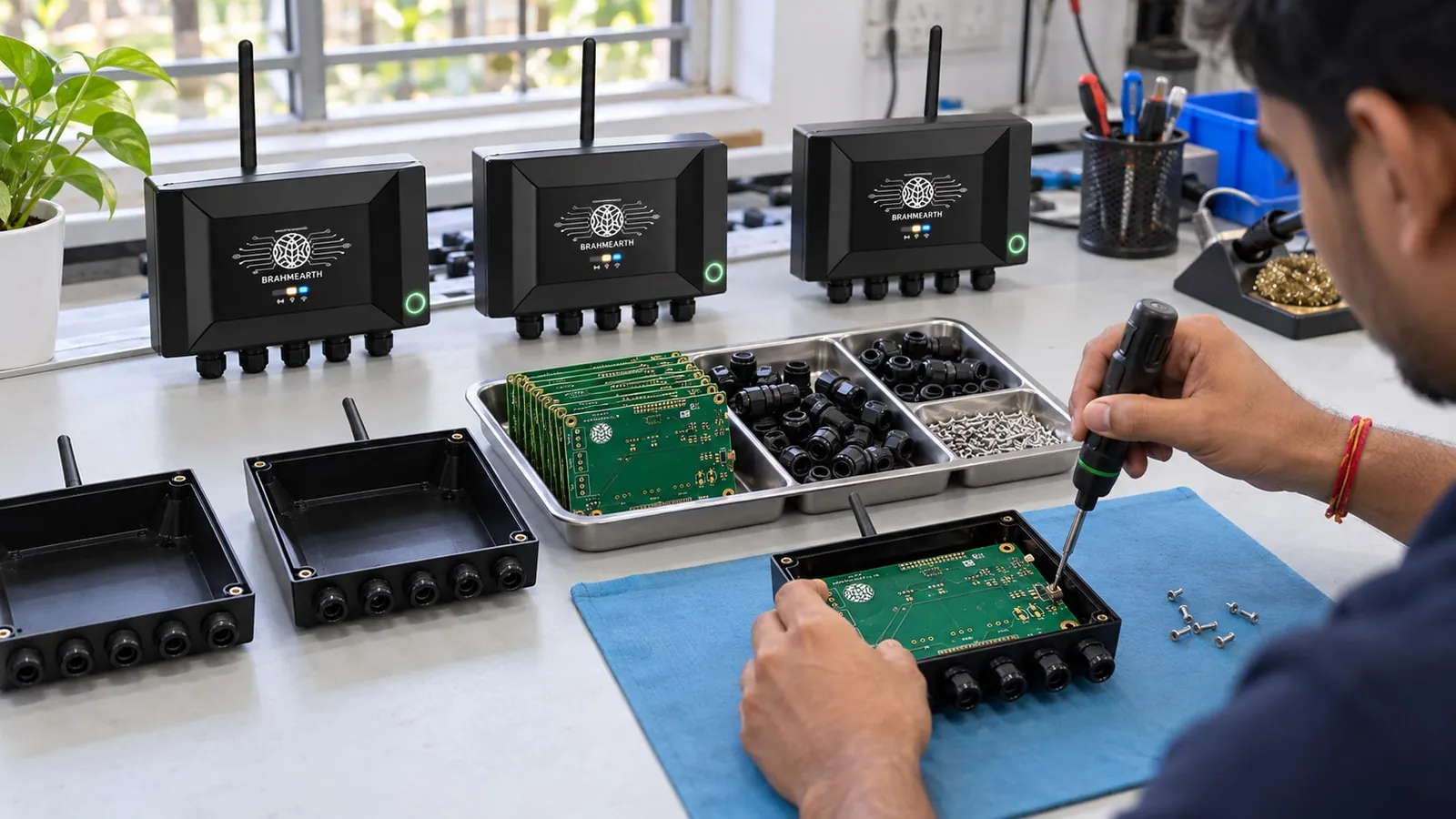
How do you design a product so someone else can assemble it?
A unit the designer can close has not passed. The designer already knows which boss to start, which way the cable folds, and which clip needs a thumbnail. The test is whether those tricks remain once the person changes. Figures below are hypothetical teaching maths, not BrahmWorks prices, yields, timelines or test results. A written sequence inside a production handoff is covered in How to Take a Hardware Prototype to Production.
A printed translucent housing held in a workshop
The cost sits in the decisions
Every part is identified, oriented, moved, located and secured. A cheap custom washer is still another pick and another chance to leave it out. Left and right clips that differ by a chamfer will be swapped. The expensive moment is the decision, not the last turn of a driver once the correct screw is already in the correct hole.
A cheap custom washer is still another pick and another chance to leave it out.
A theoretical minimum part count is an argument, not a trophy. A part earns its place when it must move relative to a neighbour, when it must be a different material, or when it must separate for assembly or service. A bracket that exists only because two mouldings never meet is a deletion candidate. A door that must open is not. Drop the service rule and you build something fast that cannot be repaired. That is a transfer of cost to the field, not a saving.
Orientation, location, fastener
Each part needs a stable seat before a fastener starts. Four possible rests, three of them wrong, means you are specifying care. Care is not a control. Symmetry is the clean fix: every orientation that fits is functionally the same, so the mistake cannot be made. Where symmetry would break the product, make the wrong way not fit, with a rib, a polarised connector, or a lead that misses the wrong pad. A "this side up" label is the weakest control, and it fails if it is applied after the part is already in.
Location comes from the parts. Lips, pins and nesting bosses do that. A screw used to drag two loose pieces into line is a fixture. It works until the hole is far enough out to cross-thread, and then both the screw and the moulding are rework. Geometry locates. The fastener clamps a relationship that already exists.
Keep one fastener family, one driver, one torque and one approach direction unless a joint has a written exception. Top-down order, each part placed from above and nothing trapped under a part already fitted, shortens both the sequence and the fixture. A component held in the air while another is fitted needs a second hand or a nest. Name that hold. Do not leave it as a knack.
The wrong build should not look finished
A connector that mates one way is mistake-proofing. A screw long enough to bottom in the wrong boss, and short enough to miss the thread in the right boss, is the opposite. So is a gasket that looks seated when rotated and leaks only on a test you might skip. Count the decisions. Removing one is often worth more than speeding up a decision you kept. A dearer polarised flex can beat two loose wires, because no torque check sees a reversed conductor.
Access is part of the same review. A screw behind a cable dressed in the previous step will be left soft or left out. A latch facing a wall cannot be confirmed. Each joint should be visible and reachable when it is made. If a later part must cover it, put a named check in front of that cover. End-of-line inspection is not a check of a joint you can no longer see.
Worked example: a wall sensor only the designer could close
This indoor wall sensor is invented for the exercise. It is not a BrahmWorks product. The prototype had a rear housing, a board on four screws, a soldered cable, a light pipe pressed in by hand, a loose gasket, a front on six screws of two lengths, and a label. The designer built ten. The tenth was quicker. That was practice, not a method.
A second person, given the parts and no commentary, put the light pipe in backwards because both ends fitted. A long screw went into a short boss, bottomed, and cracked it. The cable was held aside with a thumb while the front came down. The gasket was rotated by one hole and still looked seated. None of this was new to the designer. All of it was habit.
A teaching redesign, not a measured factory result: a flange so the light pipe seats one way, captured by the front rather than pressed as its own step. The soldered tail becomes a polarised connector in a channel, so the thumb is no longer the fixture. One screw length replaces two. The loose gasket becomes a moulded bead only after the sealing duty is written down as a requirement the bead still has to meet. Bosses locate the board before any screw turns. Part count falls. The change that matters is that the wrong builds stop fitting.
Labelled calculation: two decisions left in
Hypothetical teaching maths. Not a wage, a yield, a quotation or a BrahmWorks result.
Assume assembly labour at INR 180 per hour, fully loaded, invented for the sum. Assume two remaining decisions: choosing between two screw lengths, and rotating a gasket to the only orientation that seals. Assume 8 seconds each, and assume one unit in twenty is reopened for 4 minutes because a bench test noticed the gasket. That rate is an assumption. Do not quote it as observed.
Handling = 2 × 8 = 16 seconds = 16/3600 hours, times 180 = INR 0.80. Rework share = (1/20) × (4/60) = 0.00333 hours, times 180 = INR 0.60. Combined, about INR 1.40 per unit before a cracked boss, a shipped leak, or training.
At an assumed 8,000 units, 1.40 × 8,000 = INR 11,200. If deleting the gasket needs a tool change assumed at INR 40,000, this labour sum does not pay for the steel. Say that plainly. The change then rests on leaks you refuse to ship, on a later quantity, or on service. The arithmetic only retires the claim that the screws "only take a second". The risk was the wrong part that still looked finished.
Checklist before you call the assembly designed
- Each part earns its place: relative motion, a different material, assembly access, or service.
- Left and right, long and short, are one part, or the wrong one does not fit.
- One stable orientation, or every orientation that fits is equivalent.
- Parts locate before fasteners. Fasteners clamp. They do not align.
- One fastener family and one direction, or a written exception.
- Top-down where the product allows it. Trapped parts are named.
- Every joint is visible and reachable when it is made.
- A covered joint has a check before the cover.
- Cables sit in a channel or a connector, not under a thumb.
- Someone other than the designer has built from the written order alone.
- Service access remains, or the product is explicitly not serviceable.
- Sequence, torque and checks match the part revision.
Related questions
Is fewer parts always better assembly?
No. Two plain parts can be more repeatable than one part that must be flexed or aligned in a way only one person has practised. The part-count test deletes parts that do no work. It does not reward a clever part that hides the difficulty in a knack. Count unstable holds and irreversible mistakes, not only bill-of-materials lines.
Should snaps replace every screw?
A snap deletes a driver cycle and can delete a service path. It may also be the spring that creep and fatigue will own. Use one where the joint closes once, the flex is in a direction the tool can form, and a broken snap is obvious. Keep a screw where you need a measurable clamp, a reopening, or a joint you will not trust after time under load. Duty decides, not a wish for fewer lines.
Does any of this matter at fifty units?
Fifty units can still crack the short boss and still leak past a rotated gasket. You may refuse a tool change at that quantity. You should still remove decisions that scrap parts. Defer the fixture and the station plan if you must. Do not defer geometry that lets a wrong build look complete.
Who should try the sequence?
Someone who did not design it, with the written order and no spoken help. A time for that person on that day is usable only if labelled as such. Record the hesitations: the wrong screw, the part held in mid-air, the question they had to ask. Each one is a design change or a missing sentence. A smooth build by the designer is not the missing evidence.
Have someone else build this revision
Bring the current parts, the order you believe is right, and the holds you still do with your own hands. BrahmWorks can sort each hold into a written step, a fixture, or a part that should not be there.