
What are the common hardware product development failures?
Each failure below has an early sign, visible while a change is still a drawing. This list does not set out how to frame a product, how to measure a pilot, or how to treat a yield. Where the mistake is believing a pass that came from a setup allowed to fake the decision, the limit on that setup is in Hardware Product Development Process Explained. The arithmetic here is hypothetical teaching maths. It is not a BrahmWorks measurement and not a tolerancing standard you should copy onto a drawing.
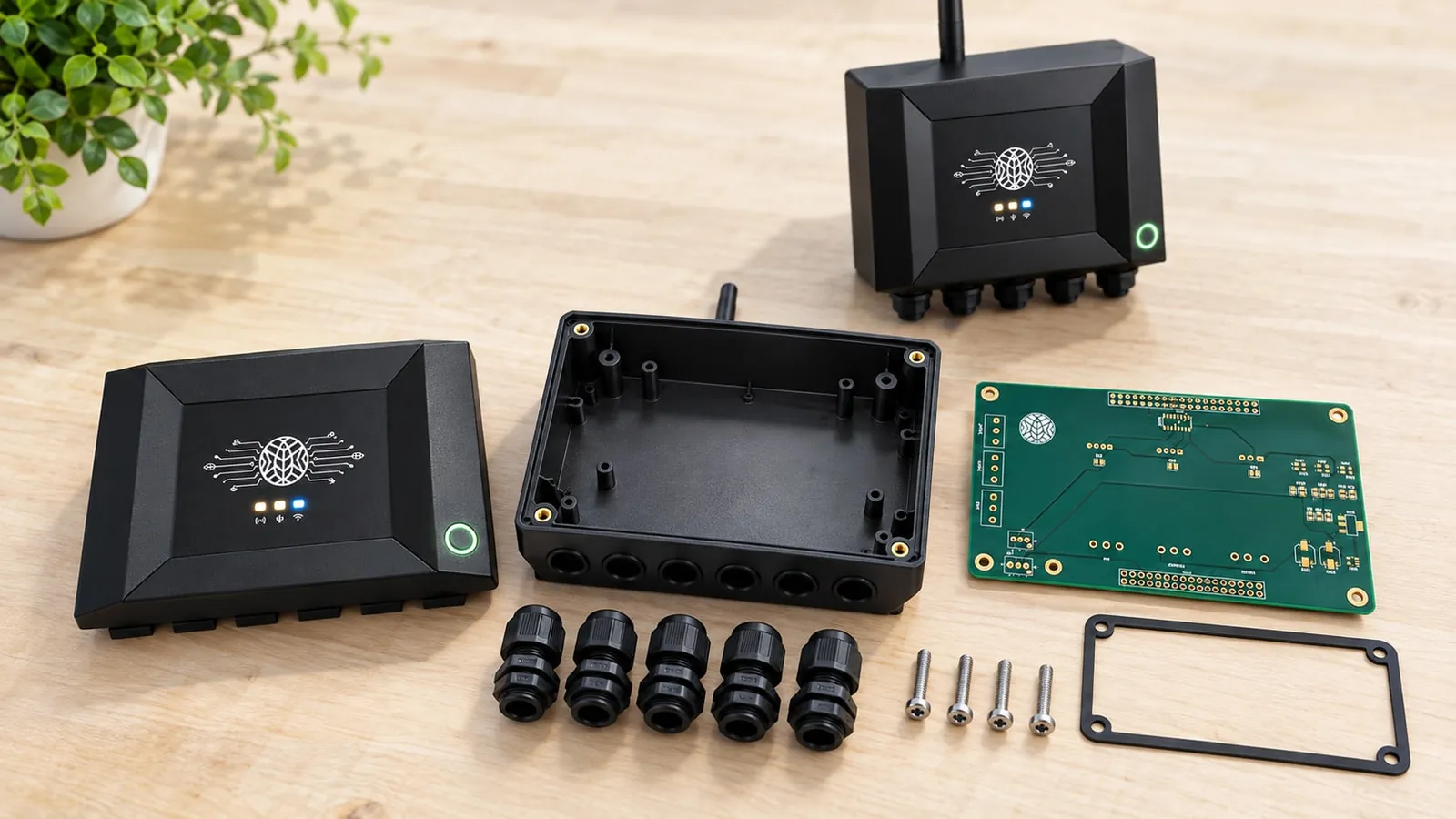
A green circuit board designed by BrahmWorks
A preference frozen as a constraint
"It has to be 12 millimetres thick" often began as a liking, or as a competitor's brochure. Treated as a constraint, it then forces a cell, a connector and a wall section that cannot all be true. The failure is not the thickness. It is the missing label. When every sentence is a constraint, nobody is allowed to trade, so the last engineer to touch the file trades in silence, or the work stops while people negotiate taste with the language of physics.
"It has to be 12 millimetres thick" often began as a liking, or as a competitor's brochure.
The early sign is a requirement nobody can attach to a user, a hazard or a rule you are obliged to meet. Ask which statements are allowed to lose. If the answer is that none of them can, you do not have a set of requirements. You have a wish list, and the design will fail one wish late, when failing it means cutting steel or disappointing a customer who was shown the wish.
A part you cannot actually buy
The prototype used a module a distributor happened to have that week. The production drawing copied the land pattern. Months later the part is on a last-time buy, or the "equivalent" in the next reel has a different voltage on one pin and the same outline. The visible failure is a respin. The quieter failure is a substitute that ships because the outline matches and nobody re-reads the pin table.
The early sign is a bill of materials with no manufacturer part number, no second source, and nobody who has checked whether the part is still being made. A screenshot of a catalogue page is not a supply plan. For any part whose absence stops the build, write the number, the lifecycle, and what you would do if it disappeared. Do that before the enclosure treats the footprint as a fixed volume. A footprint is a supply decision as much as it is a copper decision.
Tolerances that were never a stack
Each drawing is toleranced to something the author thinks is ordinary. The assembly cares about the sum, on the datum the function actually uses. A connector can meet its own drawing and still miss the opening in the housing, because the opening, the board datum and the connector body were toleranced by three people who never added the numbers. The prototype concealed it. One person chose parts that sat in the middle and eased the plastic with a blade. The blade was not a process, and it was not written down, so the tooled part is the first honest build. It is then described as a supplier defect.
Worked example: clearance around a connector
The teaching product is a boxed instrument. A connector has to sit in a housing opening with a nominal clearance of 0.30 mm on the side that matters. Three contributors are assumed, symmetric, for the exercise only:
- Position of the housing opening: ±0.15 mm
- Connector body: ±0.10 mm
- Board datum that locates the connector: ±0.10 mm
These are not drawing defaults, not a capability study, and not a result from a BrahmWorks product. They are here so a worst case and a statistical sum can be put next to each other and seen to disagree.
Teaching maths: worst case, root-sum-square, and a bias
Worst case adds the absolute tolerances: 0.15 + 0.10 + 0.10 = 0.35 mm. The nominal clearance is only 0.30 mm. Worst case exceeds it by 0.35 − 0.30 = 0.05 mm. Interference is possible if every contributor sits at its bad extreme in the same direction.
Root-sum-square treats the same three as independent, centred contributors. Take the square root of 0.15² + 0.10² + 0.10². The squares are 0.0225, 0.01 and 0.01. Their sum is 0.0425. The square root of 0.0425 is 0.206 mm. Against the 0.30 mm nominal, the margin that remains is 0.30 − 0.206 = 0.094 mm.
The two sums do not agree, and that disagreement is the point of doing both. Worst case says the design can interfere. Root-sum-square says a typical scatter might fit, with 0.094 mm left on the nominal. Neither sum is a measurement of your parts. Root-sum-square also assumes the contributors are centred. A moulded housing often is not. Shrink is a bias, a shift of the average, not another ± term.
Assume, still only for the exercise, a bias of 0.08 mm that eats clearance. The nominal clearance becomes 0.30 − 0.08 = 0.22 mm. The 0.206 mm root-sum-square now sits inside a 0.22 mm gap, and the remainder is 0.22 − 0.206 = 0.014 mm. The comfortable 0.094 mm was what you get when the bias is left out of the story. It was not a property of the parts.
Do not respond by adding margin on every dimension. Margin on a cosmetic seam may be free. Margin on a seal, a snap or a shield can can destroy the function you were trying to protect. Add the contributors the function uses, keep bias separate from scatter, and change the datum or the process where the sum is unacceptable. A blade on one prototype is not a process for removing 0.05 mm, and it will not be present on the line.
A pass copied from the wrong build
An open board on a bench stays cooler, stays dry and sees a stiff supply. The product is closed, perhaps in the sun, and perhaps on a cell. Or the firmware passed on one board, and the board you will build has a different regulator or a different layout revision. The note says the product passed. The note is about a unit you are not going to ship. Using it to release the unit you are going to ship is a bookkeeping failure with physical consequences.
The early sign is a test note with no mechanical revision, no board revision and no firmware identity, or with those fields filled from memory the next day. A pass that cannot be tied to one configuration cannot be repeated, and it cannot be revoked when the configuration changes. When a small firmware fix also changes timing or current, the note has to say which older passes are still about this product. Silence reads, later, as if everything still stood.
A close cousin is the split review. The enclosure is approved in one meeting and the board in another. The cable, the fastener and the antenna are in neither set of minutes. They meet for the first time in a build that is already late, and each team can show that its own review passed. The product did not have a review. Two components of it did.
Early sign against the expensive form
The right-hand column is not a forecast for your project. It is what this class of mistake looks like after the money has been spent. The left-hand column is available while the spend is still a drawing and a conversation. Teams that only discuss the right-hand column are already in it.
Checklist
- Every requirement is marked as a constraint or a preference, and preferences have a way to lose.
- Parts that can stop the build have a manufacturer number, a lifecycle check and a path if they vanish.
- The stack for a fit, a seal or a connector is added, with bias kept separate from scatter.
- Adjustments made on prototypes are written, or they are removed from the design.
- Thermal, radio and supply results name the enclosure and the supply that were present.
- Every pass names the mechanical revision, the board revision and the firmware identity.
- A change lists which older results are now void.
- Enclosure, board and cables were reviewed on one model, in one meeting.
- Safety behaviour has an owner. It is not an item on a backlog.
- "We will fix it in production" names a design change, a process change, or an accepted limit with an owner.
Related questions
Is a certification surprise the same kind of failure?
It is the same pattern. A constraint appears after the geometry can no longer absorb it. Name the markets and the claims before you freeze a tool, and ask a qualified person which changes void the evidence you plan to rely on. A bundle of tests bought at the end, for a product that made the wrong claim, is not a recovery. It is a new design, and it should be estimated as one. Discovering the regime in the laboratory's rejection letter is late in the way a late stack is late.
Why do convincing demonstrations fail in the field?
Because the demonstration was an easier product. A stiff supply, an open lid, a unit someone selected, a person standing there to restart it. The field has the cell or the real supply, the closed product, an ordinary unit, and nobody whose job is to make that hour succeed. Keep the demonstration, if it is useful, and label it as one. Do not file it as the verification record unless the configuration matches the unit you will ship. The feeling in the room is not a configuration.
What is revision skew?
Revision skew is using a result to bless a different design from the one that was tested. The difference often looks too small to mention. A regulator with the same headline current. An antenna moved a few millimetres. A firmware build whose only "fix" also changed how often the radio retries. The failure is the bookkeeping that let the old pass survive the change. If you cannot list the results that still apply, you do not have a pass. You have a story about a pass, and stories are what get repeated in the field failure review.
Should you add a large margin so the stack does not matter?
A margin you did not compute is a guess, and it may fight a requirement you also care about, such as a seal or a size. Compute the contributors that move the function you are worried about. Where the worst case is unacceptable and the process can hold one datum more tightly, tighten that datum rather than every number on the sheet. Where a bias dominates, change the nominal or the material assumption. Adding decimal places to every dimension feels like rigour and usually buys cost without buying the fit.
One review, not two approvals
BrahmWorks has worked on UltraFast EV charging hardware, where the enclosure, screen mounting, cable routing, component access and electronics have to be reviewed together. Approving a housing in one meeting and the electronics in another is how a cable path or a service point is left without an owner. Electrical safety and compliance remain their own scope. No yield, cost, time or test result from that charging work is stated here.
Review the failure you are nearest to
Bring the requirement list, the bill of materials and the latest test record, including the units that did not pass. BrahmWorks can say which of these failures is already visible in the evidence, and which correction is still only a change to a drawing.