
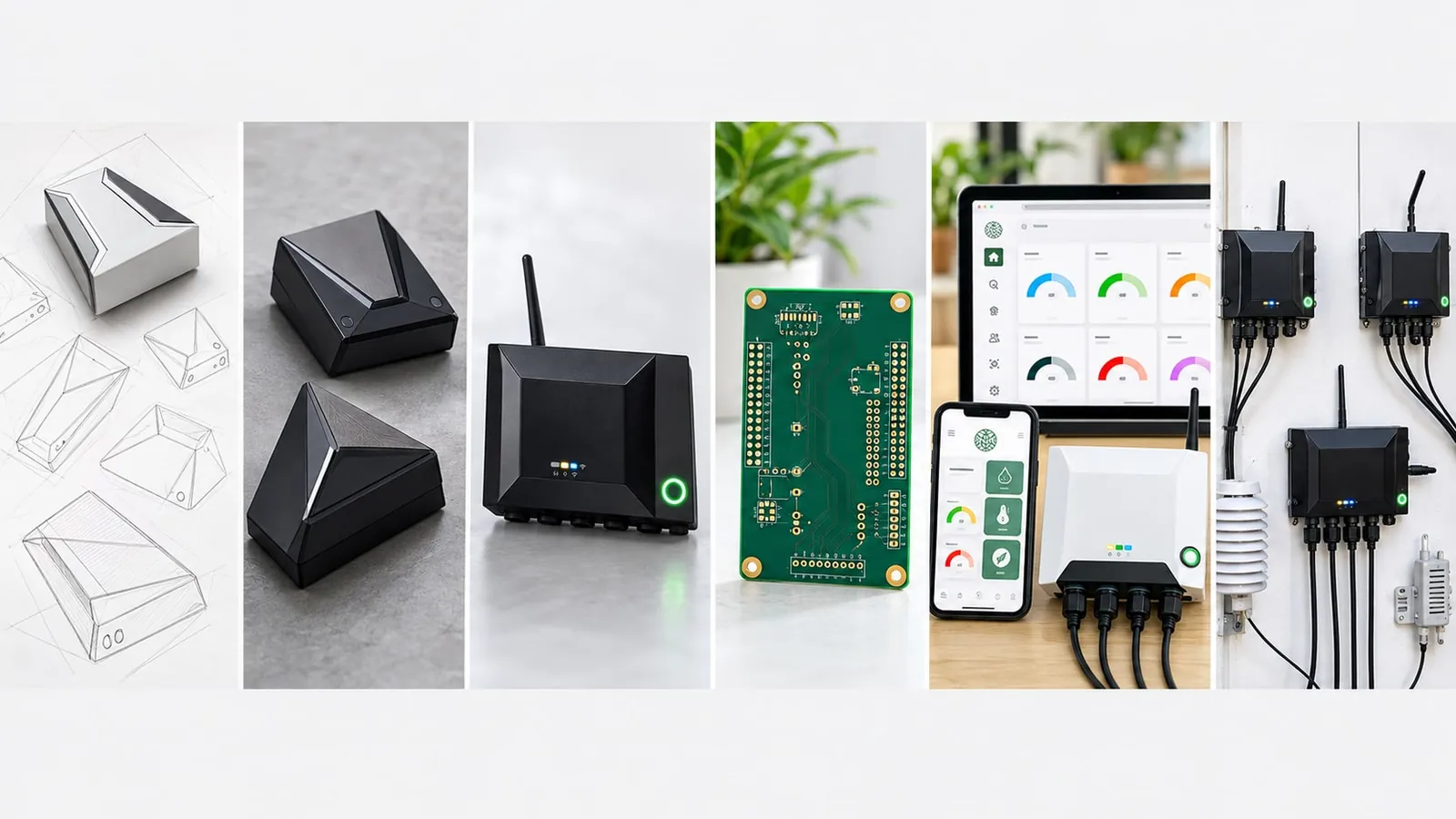
How do you develop a consumer electronics product?
Decide the one job and the one context before the feature list. A kitchen timer that a cook can start with wet hands is a product. A "platform for time" is not. Retail packaging, spare parts and a way to explain a failure are part of the same scope if you intend to sell the unit rather than to accompany it. Stage questions are set out in Hardware Product Development Process Explained. The assembly sum below is invented teaching arithmetic, not a BrahmWorks time, price, yield or test result.
A robotic hand prototype with an exposed board
Appearance is a requirement when people judge with their hands
In this category the outside is not applied after the engineering. Seams, gaps, a battery door, a connector a person will insert the wrong way, and a screen that must be read at arm's length are functional. Specify the ones that would make a buyer think the unit is broken, and the ones you will not spend on. An unspecified "premium feel" becomes an argument in every review. A maximum step at a split line, or a door that must close one-handed, can be checked.
Seams, gaps, a battery door, a connector a person will insert the wrong way, and a screen that must be read at arm's length are functional.
The inside still drives the outside. A connector, a speaker, an antenna and a cell have thickness. If the industrial design freezes a shell that cannot hold them, the electronics will be compromised in ways that do not show in a render: a flexed board, a cable across a button, an antenna against metal. Review the stack of real parts inside the intended volume before you fall in love with the silhouette. A printed model is useful for the hand and useless as a strength or a production material. Say which of those you are learning.
Colour, texture and graphics have manufacturing consequences. A finish that marks when handled on the line needs a process, not a warning. A graphic that must align to a window needs a datum. Choose them when you know the process, and keep a plain version available so a functional trial is not waiting on a cosmetic tool.
The second unit is the point
Consumer products fail when the second build cannot repeat the first. The first unit often contains bent tabs, chosen screws, firmware loaded by hand and a fit eased with a blade. Log each one as a design change, a fixture or a work-instruction step. If it stays in memory, the next batch will not match, and the mismatch will be called a quality mystery.
Order matters because parts cover each other. A cable pinched only when the lid is closed a certain way will pass a careful prototype and fail a quicker one. Have someone who did not design the product build one unit from the instruction. Write the hesitations before you time anything.
What the buyer meets includes the first charge and the first mistake. A unit that is dead until a secret button is held is a support problem, as is onboarding that depends on an app you have not staffed. If the job can be finished on the device, do not make an account mandatory yet. A non-replaceable cell needs an honest life story, or you are designing a return. This article does not give that life as a number.
A trial is not a launch
A trial with people outside the company is how you learn the job. It is not a licence to ship. Tell the participant what is missing, how to stop using the unit, and what you will do if it misbehaves. Do not describe a friendly week as demand, and do not describe a drop onto carpet as a durability result. If you need a durability question answered, define the drop, the surface and the pass condition before you let go of the unit, and keep that record apart from anecdotes.
Compliance for mains, radio, batteries and children's products is its own scope. Identify it early enough that the enclosure can still change. A working prototype is not a mark, and a mark you have not started is not "standard later". Name the markets. Do not assume they share rules.
Worked example: a one-button kitchen timer
The teaching product is a timer a cook starts and stops with one button, readable from the hob, and able to be wiped. It is not a BrahmWorks project and not a tested product. The prototype question is whether a person who was not shown the trick can start it with wet fingers, cancel it without a manual, and whether a second builder can close the shell without pinching the speaker wires.
In the build: the button, the display, the wipeable face, the cell door if the cell is replaceable, and the assembly instruction. Out of the build: a phone application, a family of finishes, and any life or drop claim. A printed shell is allowed for the hand question. It is not allowed to stand in for a moulded clip or for a wipe that attacks a particular resin. If the cook cannot tell whether the timer is running, the interface has failed. A second screen of settings is not the remedy.
Forbidden conclusions: retail demand, a waterproof rating, and any assembly time other than the teaching sum below, which is not a measurement of this fictional unit either.
Labelled calculation: minutes that repeat
These minutes are assumed so the comparison can be checked. They are not a time study and not a BrahmWorks result.
Assume route A closes the shell with 14 screws and 6 cable ties, and takes 9 minutes once the person already knows the product. Assume route B uses 4 screws and integral clips, and takes 4 minutes on the same assumption. The difference is 5 minutes a unit.
At an assumed 200 units, 5 times 200 is 1,000 minutes, which is 16 hours and 40 minutes of assembly time. That is not money, not a wage and not a quote. It is the size of the difference hiding in a fastener decision. It ignores training, rework, scrap and the time you spend because route B's clips need a tool change you have not designed. If the clips then fail and each unit needs 3 extra minutes of rework, the 5-minute advantage becomes 2, and at 200 units you have saved 400 minutes on paper while adding a defect the screw route did not have. Count rework in the same sum before you celebrate the clips. Do not turn the minutes into a price.
What a handsome unit still owes you
Checklist
- The job and the place are one sentence a buyer would recognise.
- Seams, buttons, doors and readability are specified, or called out as not yet specified.
- Real parts have been stacked in the intended volume.
- Every workaround on the first unit is a design change, a fixture or an instruction.
- Someone other than the designer has built a unit and used it without coaching.
- First power-on does not depend on a secret or an unstaffed app.
- Replaceable parts and expected support are named.
- Mains, radio, battery and market marks are a separate scope.
Related questions
When does appearance become engineering?
When a person will judge function by a gap, a rattle, a button feel or a screen they cannot read. Specify those checks. Leave taste to a decision you record, so it does not reopen every sample.
Can packaging wait?
The carton can wait. The fact that the unit must survive a carton, a shelf and a first opening should not. A battery that falls out, or a film the buyer cannot remove, is a product defect found in the cheapest possible trial. Do that trial before the tool is cut.
How is a pilot user different from a buyer?
A pilot user has been told what is missing and how the trial ends. A buyer has been sold a promise. Do not use one word for both. Evidence from a coached weekend does not price a warranty.
Why do second builds disappoint?
Because the first unit contained unlogged adjustments. The second build is the first honest look at the design. Treat its differences as findings, not as a manufacturer being difficult.
Review the job a stranger can finish
Bring the job sentence, the workaround log and the instruction a second person used. BrahmWorks can say whether the next build is still a prototype of the function, or whether you are ready to engineer the repetition a consumer product cannot avoid.