
What is mechanical reliability testing, and what can it prove?
A pass on a few units is evidence about those units and that method. It is not a field failure rate, and it is not a life for every unit you will ship. The counts below are hypothetical teaching maths. They are not BrahmWorks results, not a standard's requirement and not a reliability percentage. The duty in your requirement replaces them.
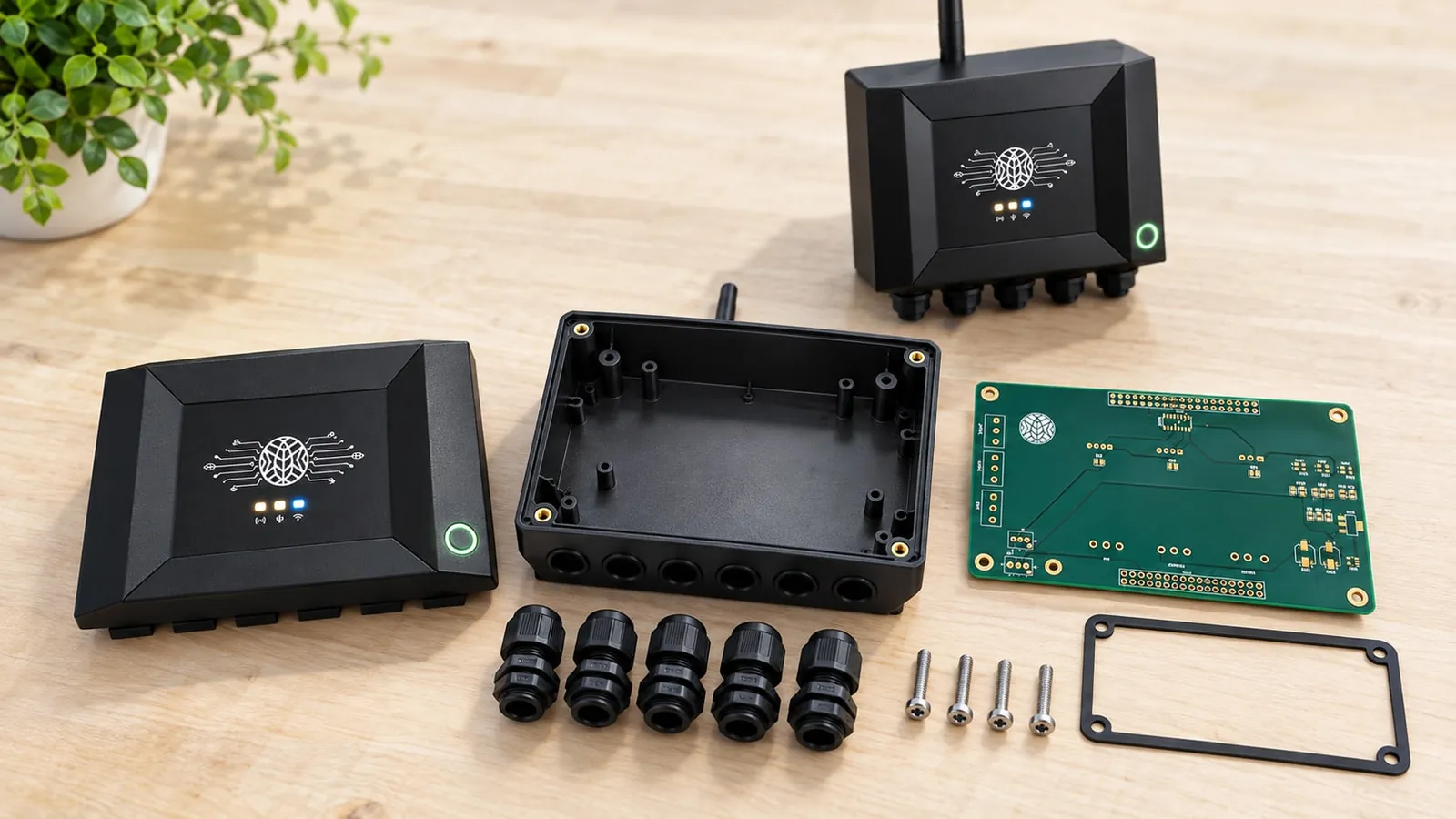
A green circuit board designed by BrahmWorks
Separate three different tests
Design verification asks whether the design meets a limit on a named revision, in materials close enough that the answer can transfer. End-of-line testing asks whether this unit was built. A short button check is not a life test. An external scheme is whatever a qualified lab tells you applies, early enough to change the design. This article is not that scheme.
Design verification asks whether the design meets a limit on a named revision, in materials close enough that the answer can transfer.
A lab report on another revision, or an end-of-line pass, is not "reliability done".
Write the duty, then the method
Start from use. Who drops it, from what height, onto what? Who opens the door? Does survive mean no crack, or no crack and still working? A scuff may be acceptable. A cracked boss is not. Say which.
Write a method someone else can run: unit identity, revisions, orientation, height or load, cycles, the pass limit, and the record. Photographs and a measured gap count. "Looked fine" does not.
A small sample can find a design fault. It cannot estimate a field percentage. Three passes are not 99 percent of units. Say that in the report. If you need a statistical claim, that is a different plan. Do not borrow a sample size from this article.
What mechanical tests usually cover
Cycle latches, doors, connectors, buttons and hinges on the production material. A printed clip's count does not transfer. Any extra factor on the use-case count is a judgement, labelled as one.
Drops need a surface, a height and an orientation. Shipping shock and vibration on an installed machine are different duties. Creep is the quiet failure: a clip, a compressed gasket or a boss at temperature can pass on day one and relax later. Some polymers crack under stress plus a chemical they tolerate when unstressed. Name the chemical. Torque bosses to the installation value. Test the pack you will sell, or do not claim the shipment.
Worked example: a door and a drop
Invented indoor instrument, battery door opened by a technician, not a consumer toy. Assumed use: the cell is changed once a month, the product is kept for four years, and it may be dropped once in its life from bench height during install. None of this is a measured field rate.
Monthly for four years is 12 × 4 = 48 openings. That count has no margin for a technician who checks the cell more often, and no scatter. A teaching judgement, not data, is to test 150 cycles, roughly three times the assumed use, and to treat the factor of three as a choice you could have set to two or to five. Pass, assumed for the exercise: the door still closes, the cell stays retained, no crack at a ten-times visual check. A pass at 150 cycles on five doors would support "this revision survived this method". It would not support a yearly failure percentage.
The drop assumption: 1.0 m onto a stated hard surface, one drop on each of six faces, unit complete with cell. Pass: door stays closed, cell retained, no crack through a boss. Function after the drop, including the radio, is a separate electrical record on the same units. A mechanical pass does not imply the radio still meets its limit. No such drop has been run for this article.
Labelled calculation: do not turn cycles into a rate
Assumed use is 48 openings in life. Test count is 150. The ratio 150 / 48 = 3.125, which is the factor you assumed, seen from the other end. It is not a safety factor measured in the field.
Suppose, as a further invention, that one of five doors cracks at cycle 90. You do not have a failure rate. You have one door, on this revision, that did not reach the test count, and four that did. The disposition is: stop and understand the crack, change the design or the requirement, and repeat the relevant test. Averaging 90 with four passes to a mean life is how a single design fault gets a percentage and then a pass.
If all five reach 150, you still do not compute 0 failures in 5 as a field reliability. You file the method, the revision and the limit. Any later change to the resin, the boss or the door geometry voids the run. The void list is part of the result.
Those records are what a release pack needs when someone else will build the unit. The pack is described in How to Take a Hardware Prototype to Production.
A failure is a result
Keep the failed unit as it failed until it has been seen. Then change the design, change the limit, or accept the gap with an owner. A retest that changes three other things proves none of them. Units you excluded from the sample belong in the note. A room-temperature cycle is a partial if the duty includes heat or a chemical. Mark it partial.
Checklist for a mechanical reliability plan
- The duty is a use, a count or a height, and a definition of survive.
- The method names revision, setup, orientation, cycles or load, and the record.
- Design verification, end-of-line and any external scheme are separate files.
- The sample size is stated, with what a pass does not claim.
- Any multiplier on life is labelled as a judgement.
- The material is the production material, or the limit on the conclusion is written.
- Creep, heat, chemical and sunlight are in the plan or listed as out of duty.
- Packaging is included if you claim shipping.
- A failure stops the configuration. It is not averaged with passes.
- A design change voids the listed runs until they are repeated.
- Function after mechanical stress is its own record, not assumed.
- No result in the plan is a number copied from this article.
Related questions
Is a drop test a certification?
No. A drop test is a method plus a result on a revision. A certification is whatever the applicable scheme says, run by the party that scheme requires, on the build that scheme requires. Your bench drop can be the right design check and still be useless as a market approval. It can also be harsher than the scheme, or milder. Compare the methods before you claim either one covers the other.
How many samples are enough?
Enough to see a gross design fault is not enough to estimate a field rate. Early in design, a handful of production-intent parts, tested to a written method, will show a boss that strips or a door that cracks. That is worth doing. Publish the count and the limit. If someone needs a probability, stop and design that study. Do not let five passes become a percentage in a pitch.
Can you reliability-test a printed part?
You can test a print for print failures: layer splits, a weak orientation, a fixture problem. You cannot use it as the life of a moulded grade. If production is moulded, the test that counts is on moulded parts in that grade, after the geometry has the draft and the thickness you will ship. Use prints to find the obvious clash earlier. Label those runs as void for the reliability file.
What if the test is harsher than any user?
Then you may be rejecting a design the duty allows, or you may be buying margin you decided you want. Write the factor down as a choice. A 150-cycle test against 48 assumed uses is that kind of choice. It is honest if you can say why. It is not honest if the count was picked because the actuator was free overnight and the pass is then described as "field life".
Review the plan against the duty
Bring the requirement, the method and the revision the units actually are. BrahmWorks can say whether that plan tests the design or tests a stand-in, and which result is being asked to carry more than it can.