
How do you develop hardware for smart agriculture?
BrahmEarth is a real BrahmWorks family of sensor nodes for this kind of environment. This article does not state a range, a life, an accuracy or any other performance figure for BrahmEarth or for any other product. A node in that family still has to be reviewed as enclosure, sensing path and electronics together. The questions a development stage is allowed to close are set out in Hardware Product Development Process Explained. The visit sum below uses assumed rates. It is not field data and not a BrahmWorks result.
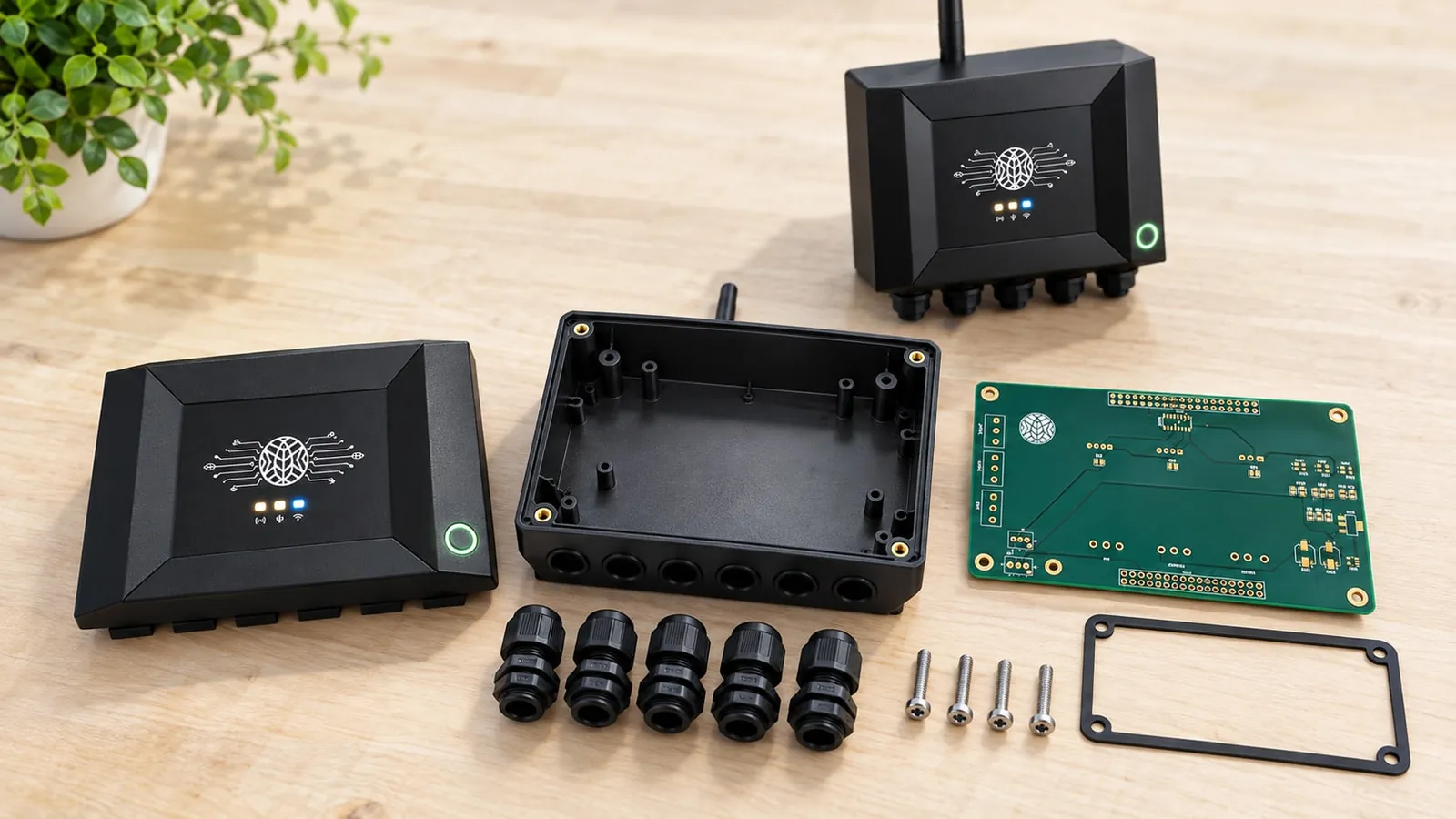
A green circuit board designed by BrahmWorks
The decision comes before the node
Write the decision in the user's words. "Do I irrigate this plot today?" is a decision. "Soil intelligence" is not. Then write what the device is allowed to contribute: a reading, a comparison with yesterday, a lamp, nothing more. If a person must still walk the plot, say so. A product that implies it replaces a walk, when it only samples one point, will be blamed for the corner it never saw.
Then write what the device is allowed to contribute: a reading, a comparison with yesterday, a lamp, nothing more.
Name the point of measurement. Depth, height above the canopy, shade, and whether the sensor sits in soil, air or water. A figure from the wrong point is worse than no figure, because it looks like certainty. The prototype question should include the mounting a real person will achieve, not the mounting in the CAD. If the node can be installed facing the sun when it must face the soil, someone will install it that way. Make the wrong orientation obvious, or expect the data to be the wrong orientation.
Power and reach are field facts. Mains may not exist. A battery change is a visit. A radio path that worked in a car park may not work through a crop or a wet canopy. Write the assumption, and test it in the crop if the radio question is the one you are funding. Do not borrow a link result from an empty site.
The environment is the design
Sun heats a dark enclosure and can shift a reading or a supply. Rain and irrigation enter through glands, display windows, battery doors and the thread someone leaves loose. Dust packs into a port. Animals and machinery strike anything proud of the ground. None of these is a "later ruggedisation". If the decision depends on the unit surviving them, the prototype that answers survival has to see them, or the claim stays off the page.
The sensing element has a relationship with the shell. A membrane, a soil interface or an optical window is part of the measurement. Glue, a rib or a trapped bubble can dominate the reading. Review that stack as one assembly. Replacing the element with a "better" part does not fix a window that is shadowed or flooded.
Service in the field is awkward. Gloves, mud, one free hand, no laptop. A procedure that needs a phone application and a password will be skipped, and the skip will look like a sensor fault. Prefer a local indication for the faults an installer can fix, and write the ones they cannot. Spares and mounts should be something a person can carry to the plot you named, not a workshop fantasy.
What you must not infer
A week of data from one plot does not describe a farm, a season or a crop you did not instrument. A correlation someone sees in a spreadsheet is not a control algorithm. If the product will drive a valve or a pump, that act needs its own safe behaviour when the reading is missing or absurd. Do not let a dashboard command equipment by default because the chart looked plausible.
Compliance and environmental claims, if you make them, are separate from a prototype that posted numbers. This article does not make those claims. It also does not rank BrahmEarth against anything. The engineering point is the same for any node: record the installation, the revision and the conclusion you are not allowed to draw.
Worked example: one plot, one depth
The teaching product helps one grower decide whether to irrigate a single plot today, using a sensor at one named depth. It is not a BrahmWorks project, not a BrahmEarth specification and not a tested product. The prototype question is whether a person who was given only the sheet can mount the node the right way up, and whether a reading taken after irrigation is marked so nobody treats a flooded hole as the plot.
In the build: the mount, a visible orientation, the depth stop, a local indication that the unit is awake, and a log that stores the last reading if the radio is absent. Out of the build: a map of the farm, automatic valve control, a custom mould, and any accuracy, range or battery figure. If the installer can face the sensing face into the sun and still think they are finished, the mount has failed the question. More software will not show them the face they buried backwards.
Forbidden conclusions: advice for other plots, any yield of crop, and any comparison with BrahmEarth. BrahmEarth remains a product family of sensor nodes. Nothing in this example measures it.
Labelled calculation: a bad install against a clearer mount
These rates and minutes are assumed for the exercise. They are not a study, not BrahmEarth field performance and not a BrahmWorks result.
Assume 20 nodes. Assume that, with a mount that can be reversed, 15 percent of first installs are reversed. 0.15 times 20 is 3 bad installs. Assume each bad install costs a 40-minute return visit. 3 times 40 is 120 minutes of visits.
Assume a keyed mount adds 2 minutes at assembly. 2 times 20 is 40 minutes. Assume, only for the exercise, that the bad rate falls from 15 percent to 5 percent. Bad installs become 1, and visits become 40 minutes. The visit time falls by 80 minutes. Against 40 extra assembly minutes, the assumed trade is 40 minutes saved, before travel, before the crop cost of a wrong reading, and before you check whether 15 and 5 were ever true.
If the true bad rate was already 5 percent, the keyed mount adds 40 minutes and saves one visit, which is also 40 minutes, and the trade is zero on these assumptions. The arithmetic does not justify the feature. It forces the rate into the open. Replace both percentages with what you see when a stranger installs the unit. Do not quote them as BrahmEarth, or as anyone else's, statistics.
What the bench leaves out
Checklist
- The decision and the point of measurement are written in the user's words.
- Wrong orientation and wrong depth are hard to do silently.
- Sun, water, dust and impact are in this build or explicitly untested.
- The sensing face, membrane or window is reviewed with the electronics.
- A missing radio does not delete the reading the decision needs.
- An actuator, if any, has a defined behaviour when the reading is absent.
- A stranger has installed a unit from the sheet, in the clothing they wear.
- No performance number is attached to BrahmEarth or to this prototype.
Related questions
What is BrahmEarth here?
It is a BrahmWorks product family of sensor nodes. Mentioning it identifies the kind of product. It does not publish a specification. Enclosure, sensing path and electronics are reviewed together. Figures for life, range or accuracy are not inferred in this article.
Can the field question be answered indoors?
Only the parts that are truly indoor: firmware, a connector, a first look at assembly. Sun, water, mounting by a non-engineer and the radio through a crop are outdoor questions. An indoor pass must not be rewritten as a season.
Who is the installer?
The person who will actually do it, with the tools they actually carry. If that person has not touched a unit, the mount is still a guess. Watch one install without helping, including the moment they are unsure.
What should a visit still check?
That the orientation, depth and power are what the decision assumes, and that the revision in the ground is the revision in the notes. A dashboard cannot see a sensor pulled out by a hose. The visit is part of the product until the design makes that class of mistake obvious.
Review the decision and the mount together
Bring the decision sentence, the mount a stranger used, and the conclusions you are not drawing. BrahmWorks can say whether the next build is still that plot question. Performance numbers are not required for that conversation, and this article does not supply them.