How to Price a Simple, Niche Consumer Product (Without Pricing Off Your BOM)
2026
Author
Sanjay M N
Publication
BrahmWorks Insights
A product with eleven parts and one job looks easy to price. Add up the parts, double it, done.
That arithmetic is how many good niche products reach the market at a price that cannot pay for the ads, the returns, or the retailer who wants to stock them. The parts were cheap, so the product was priced cheap. Then the shipping invoice arrived.
This guide is for founders building something intentionally simple: a machined desk object, a focused piece of home gear, a single-purpose everyday tool. Low part count, one clear buyer. The argument is short. Price from the value to that buyer and from your full landed cost, never from the bill of materials. In a niche, simplicity is the thing people are paying for. It is not a reason to discount.
Every rupee below is hypothetical teaching maths. It is not a BrahmWorks fee, not a supplier quote, and not a market rate. The method is the part you can reuse.
Why simple niche products get underpriced
The low-BOM cost-plus trap
Cost-plus pricing feels responsible. You know the parts cost INR 290, you add a margin, you are not “gouging” anyone. The trouble is what the BOM leaves out. On a complex product, the BOM is a large share of the real unit cost, so a markup on it lands somewhere near sane. On a simple product, the BOM is small and everything around it (packaging, freight, fulfilment, the cost of finding a buyer) stays the same size. Those fixed-size costs swallow a thin margin whole.
A machined stand and a smart speaker both need a box, a courier and an ad click. Only one of them has a BOM big enough to hide those costs.
Underpricing hurts more in a niche
In a broad market, a low price can win on volume. In a niche, volume is capped by definition. You will not sell your way out of a thin margin, because there are only so many buyers who care about your exact problem.
A low price also sends the wrong signal to exactly those buyers. People who care enough to seek out a focused product usually care about how it is made. When a solid, well-finished object is priced like an impulse buy, they start asking what was cut. Cheap reads as compromised.
And a thin margin starves the two things a niche product needs most: money to reach scattered buyers, and margin for a retailer or distributor to carry it. If there is nothing left after the courier, there is nothing for a creator collaboration, a trade show table, or a shop that wants 45%.
Start with value and the alternative, not parts cost
Anchor against what the niche pays today
Before you open the BOM, write down what your buyer does today without your product:
- The incumbent. What do they buy now, and what does it cost? Look at the premium end of the category, not the cheapest listing.
- The workaround. What do they put up with instead? A taped cable, a repurposed tray, a tool that does the job badly. Workarounds have costs too: time, mess, a replacement every year.
- The adjacent purchase. What else does this buyer spend on in the same moment? A person who owns a mechanical keyboard and a good lamp has already shown you their desk budget.
Your price sits somewhere between the alternative and the value of the job done well. The BOM sets the floor. It does not set the price.
Make simplicity read as durability and focus
Simplicity is only a premium if the buyer can see it. That is an industrial design job as much as a marketing one:
- Material honesty. Solid metal, real weight, a finish that ages well. Tell the buyer what it is made of and why.
- No visible compromise. Sharp edges broken, fasteners hidden or deliberate, consistent finish on every face.
- One job, done completely. A focused product should feel finished, not stripped. Our note on consumer product development makes the same point: decide the one job and the one context before the feature list.
- Say what you left out, and why. “No battery, no app, nothing to break” is a selling line for the right buyer.
Build your real price floor from landed cost, not the ex-factory BOM
The BOM is what the parts cost leaving the supplier. Landed cost is what one sellable unit costs sitting on your shelf, boxed and ready to ship. Then there are the costs of getting each order to a customer. Both belong in your floor.
Lines founders leave out
| Cost line | What it covers | Commonly missed because… |
|---|---|---|
| Parts / BOM | Every fitted part, including feet, screws, labels | Fasteners and labels “feel free” |
| Assembly and finishing labour | Assembly, marking, final inspection | Founder assembles prototypes for free |
| Tooling and fixtures, amortised | Fixtures, soft jaws, packaging dies, moulds spread over a planned volume | Treated as a one-off, never put in the unit cost |
| Custom packaging | Printed box, insert, care card, outer carton | Lives in a different spreadsheet |
| Inbound freight and duties | Getting parts to you, plus import duty if any part is imported | Quoted ex-works |
| QC rejects and scrap | Parts that fail inspection or get damaged | First batch is assumed perfect |
| Fulfilment | Pick, pack, storage, shipping carton | Done by the team in the early months |
| Outbound shipping | Courier per order, including remote pin codes | Averaged from the cheapest zone |
| Payment fees | Gateway or marketplace collection fees | Small percentage, ignored |
| Returns and warranty | Reverse shipping, refunds, replacements | “Our product won’t break” |
| GST and taxes | Collected from the buyer and remitted | Counted as revenue |
| Customer acquisition (CAC) | Ads, samples, creator fees, per first order | Treated as marketing, not unit economics |
For the BOM lines themselves, How to Reduce BOM Cost covers extended cost, minimum orders and why packaging belongs on the bill.
Worked example: landed cost of a simple desk stand
Illustrative example. Hypothetical teaching maths, not a BrahmWorks product, price or result.
The teaching product is a machined, anodised aluminium desk stand with silicone feet. One body, four feet, two screws. First batch: 500 units. Amounts in INR; USD shown at an assumed rate of INR 93 = US$1, for readability only.
| Line (per unit) | INR | How it was worked out |
|---|---|---|
| Parts / BOM ex-factory | 290 | Assumed supplier figure |
| Assembly, laser marking, inspection | 30 | Assumed |
| Fixtures, soft jaws, packaging die (amortised) | 80 | INR 40,000 ÷ 500 units |
| Custom packaging | 60 | Assumed |
| Inbound freight and duties | 24 | Assumed |
| QC rejects and scrap allowance | 16 | 5% × (290 + 30) = 5% × 320 |
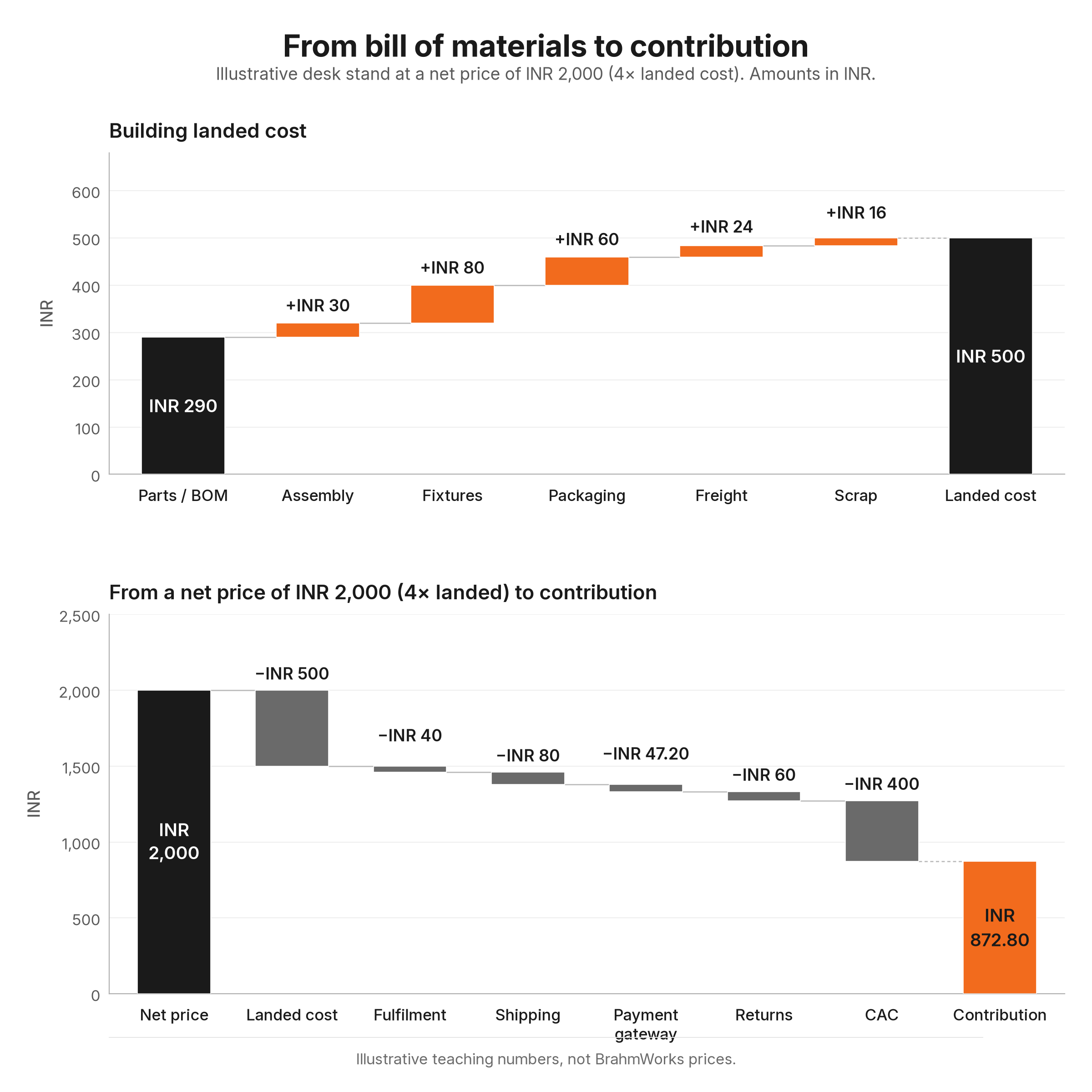
| Landed unit cost | 500 | 290 + 30 + 80 + 60 + 24 + 16 (≈ US$5.38) |
The BOM is INR 290. The landed cost is INR 500. That gap, 72% on top of the BOM, is before a single order has shipped.
Now the per-order costs for a direct-to-consumer (D2C) sale, also assumed:
- Fulfilment (pick, pack, shipping carton): INR 40
- Outbound shipping: INR 80
- Payment gateway: 2% of the amount collected (which includes GST)
- Returns and warranty reserve: 3% of the net price
- CAC: INR 400 per order
- GST: 18% assumed, collected on top of the net price and remitted. Your actual rate depends on the product’s HSN code. GST is not your money.
The 2x-of-BOM price, checked. A founder doubles the BOM: net price INR 580, MRP INR 684.40 (580 × 1.18).
580 − 500 (landed) − 40 − 80 − 13.69 (2% × 684.40) − 17.40 (3% × 580) = −INR 71.09 before any marketing. After INR 400 CAC: −INR 471.09 per order.
Every sale loses money. More sales lose more money.
The 4x–5x landed cost rule and channel math
A workable rule of thumb for simple consumer hardware: set your net selling price (before GST) at 4x to 5x landed unit cost. It is not a law. It is the range that usually survives contact with CAC, shipping, returns and a retailer’s margin, with something left over to pay back the money you spent developing the product.
Same stand, landed cost INR 500, three prices. Multiples are measured on the net price before GST.
D2C: your own website
Illustrative example. Hypothetical teaching maths.
| Per order (INR) | 2x landed | 4x landed | 5x landed |
|---|---|---|---|
| MRP incl. 18% GST | 1,180.00 | 2,360.00 | 2,950.00 |
| GST remitted | −180.00 | −360.00 | −450.00 |
| Net price | 1,000.00 | 2,000.00 | 2,500.00 |
| Landed unit cost | −500.00 | −500.00 | −500.00 |
| Fulfilment | −40.00 | −40.00 | −40.00 |
| Outbound shipping | −80.00 | −80.00 | −80.00 |
| Payment gateway (2% of MRP) | −23.60 | −47.20 | −59.00 |
| Returns / warranty (3% of net) | −30.00 | −60.00 | −75.00 |
| Contribution before CAC | 326.40 | 1,272.80 | 1,746.00 |
| CAC | −400.00 | −400.00 | −400.00 |
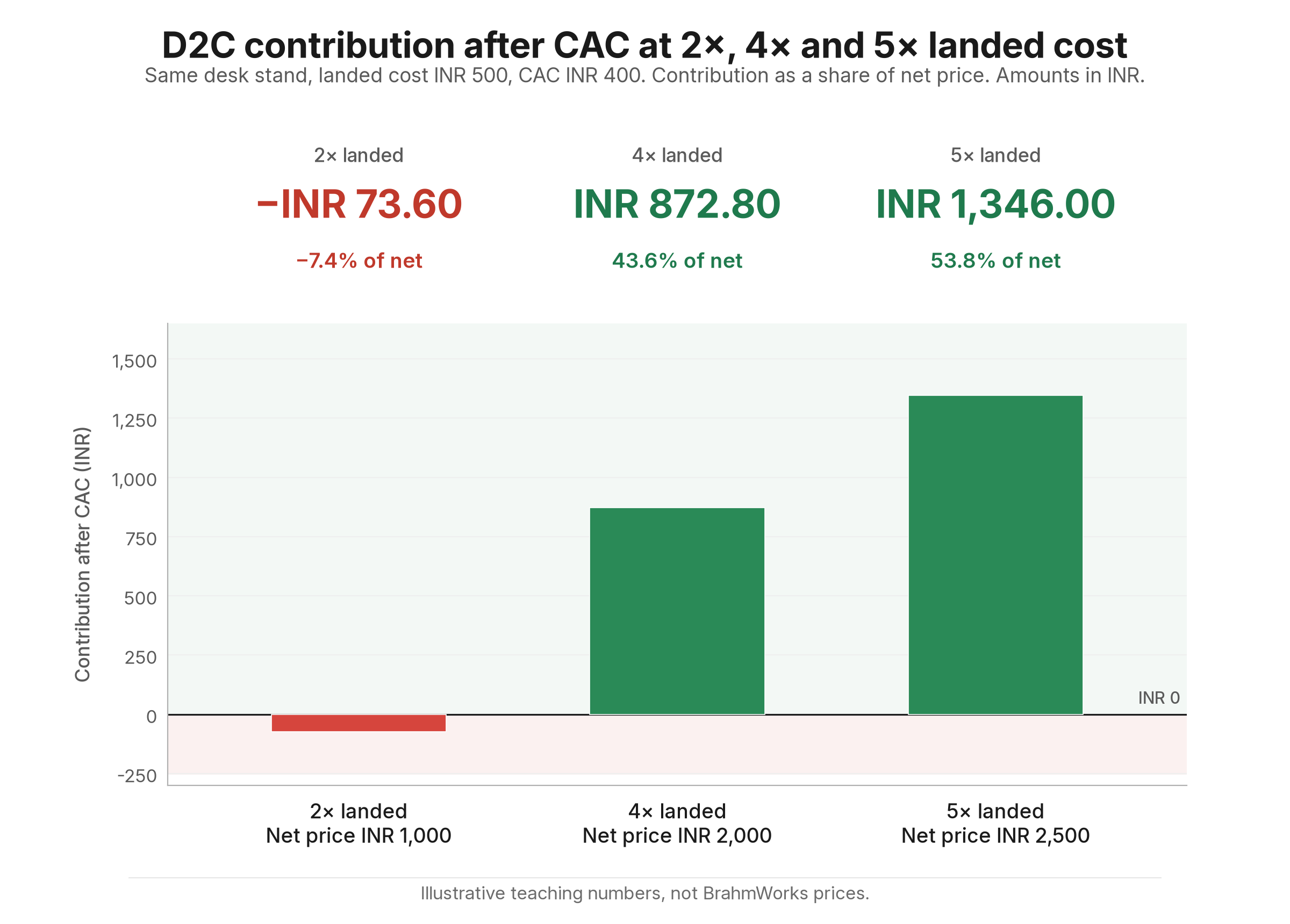
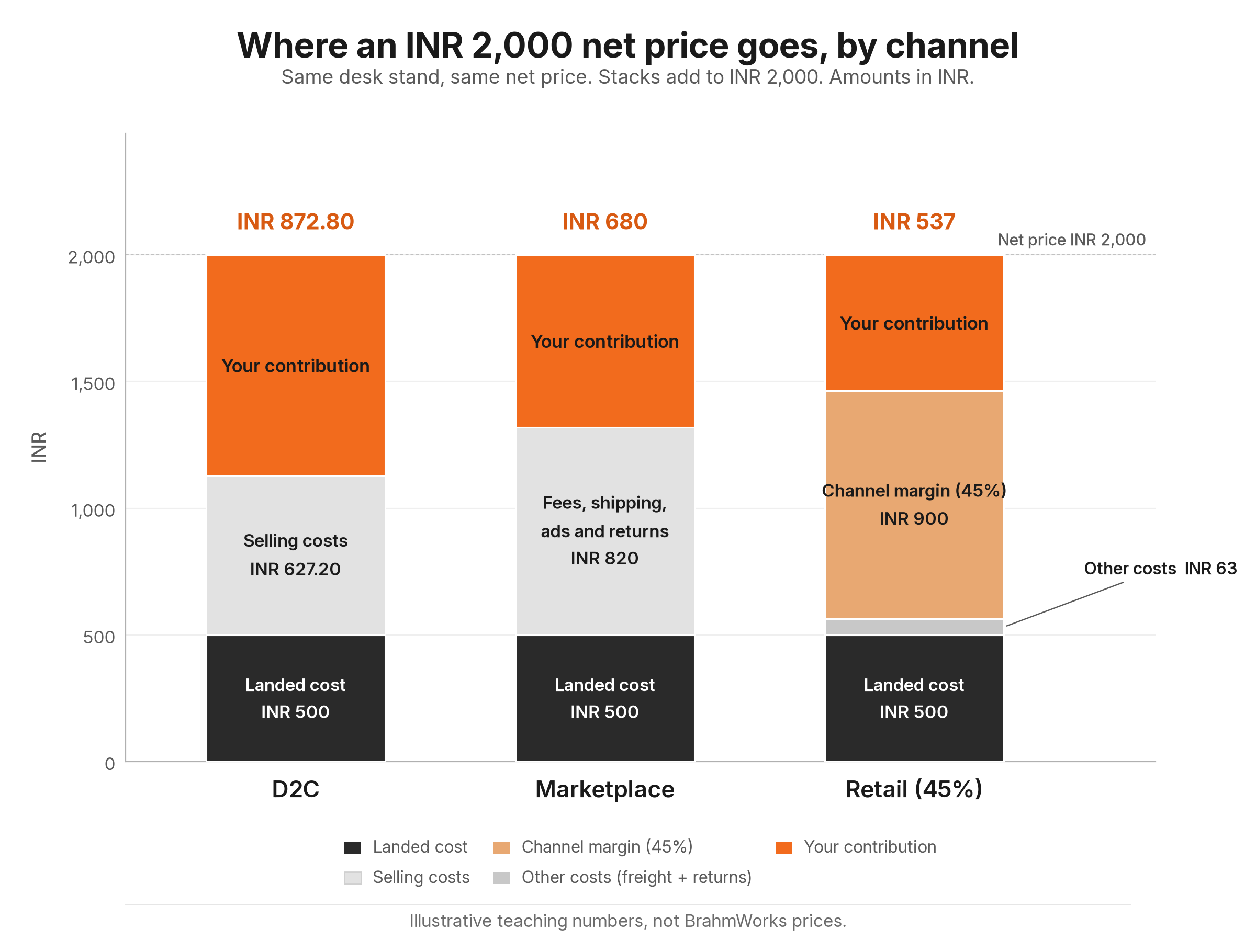
| Contribution after CAC | −73.60 | 872.80 | 1,346.00 |
| As % of net price | −7.4% | 43.6% | 53.8% |
| ≈ USD at INR 93 | −0.79 | 9.38 | 14.47 |
At 2x, the stand looks profitable until the first ad is paid for. At 4x, there is INR 872.80 per order to fund the business.
Retail and distribution
Retailers and distributors typically need roughly 40–55% of the selling price between them. Assume the channel keeps 45% of the net shelf price, you invoice the other 55%, you pay INR 30 freight to their warehouse, and reserve 3% of your invoice for returns and damage. No CAC, but slower payment.
Illustrative example. Hypothetical teaching maths.
| Per unit (INR) | 2x landed | 4x landed | 5x landed |
|---|---|---|---|
| Net shelf price | 1,000.00 | 2,000.00 | 2,500.00 |
| Channel margin (45%) | −450.00 | −900.00 | −1,125.00 |
| Your invoice | 550.00 | 1,100.00 | 1,375.00 |
| Landed unit cost | −500.00 | −500.00 | −500.00 |
| Freight to channel | −30.00 | −30.00 | −30.00 |
| Returns / damage (3% of invoice) | −16.50 | −33.00 | −41.25 |
| Your contribution | 3.50 | 537.00 | 803.75 |
| As % of your invoice | 0.6% | 48.8% | 58.5% |
If the channel asks for 55% instead of 45%, the 2x invoice drops to INR 450 and you lose INR 93.50 a unit (450 − 500 − 30 − 13.50). At 4x the invoice is INR 900 and you still keep INR 343 (900 − 500 − 30 − 27), or 38.1%.
A 2x product cannot enter retail at all. A 4x product can, even on a demanding margin.
Marketplaces
Assume marketplace fees of 20% of the net price, INR 120 for their fulfilment and shipping, sponsored ads at 10% of net, and returns at 5% of net (marketplaces tend to see more returns). GST on fees and payment timing are left out to keep the sums readable.
| Per unit (INR) | 2x landed | 4x landed | 5x landed |
|---|---|---|---|
| Net price | 1,000 | 2,000 | 2,500 |
| Landed unit cost | −500 | −500 | −500 |
| Marketplace fees (20%) | −200 | −400 | −500 |
| Fulfilment and shipping | −120 | −120 | −120 |
| Sponsored ads (10%) | −100 | −200 | −250 |
| Returns (5%) | −50 | −100 | −125 |
| Your contribution | 30 | 680 | 1,005 |
| As % of net price | 3.0% | 34.0% | 40.2% |
Set the floor with one formula
You can calculate the lowest price that still meets a target. Say you want 30% contribution after CAC on D2C. Let P be the net price:
P − 500 − 40 − 80 − 400 − (2% × 1.18 × P) − (3% × P) = 30% × P
P × (1 − 0.0236 − 0.03 − 0.30) = 1,020
P = 1,020 ÷ 0.6464 = INR 1,577.97 net, about 3.2x landed cost (MRP ≈ INR 1,862 with 18% GST; ≈ US$16.97 net).
That is the floor for one channel, at one CAC, with no discounts. The 4x–5x range sits above it for reasons that show up within the first year: a launch offer, a retailer who calls, CAC that rises when the first enthusiasts are already customers, a second batch with different costs.
Contribution also has to repay what it took to make the product. If design, prototypes, photography and certification came to an illustrative INR 6,00,000 (≈ US$6,452), then at INR 872.80 per D2C order you recover it after 688 orders (6,00,000 ÷ 872.80 = 687.4). At −INR 73.60 you never do. For how development budgets are built up, see our guide to hardware product development cost in India.
Create a price anchor, even with one simple product
A single SKU has nothing to be compared against, so the buyer compares it to the cheapest thing they have seen. Give them a better comparison without discounting the core product.
- Pro or premium finish edition. Same geometry, different material or finish: brass, bead-blast with hard anodise, a numbered run. It costs you little extra engineering and makes the standard edition look sensible.
- Starter kit or bundle. The core product plus the companion pieces the buyer would add anyway.
- Companion accessories. Small add-ons that raise order value and spread fixed per-order costs (shipping, fulfilment, CAC) over more revenue.
- Refills and spares. Replacement feet, pads or inserts. Small, but they show the product is meant to last.
Illustrative ladder (net prices before GST, hypothetical):
| SKU | Net price (INR) | Assumed landed (INR) | Multiple |
|---|---|---|---|
| Core stand | 2,000 | 500 | 4.00x |
| Desk kit: stand + cable weight + cloth | 2,700 | 660 (500 + 160) | 4.09x |
| Pro finish edition | 2,900 | 650 | 4.46x |
The kit is worth INR 2,900 if bought separately (2,000 + 900 for the add-ons). Priced at INR 2,700 it reads as a fair deal, and the core stand at INR 2,000 now sits in the middle of a range instead of alone.
Keep each tier on a shared base geometry. Variants that need their own tooling split your volume and push landed cost up for every tier.
Test willingness to pay before you lock MRP and tooling
Price is a hypothesis, the same as the product. Test it while it is still cheap to change, before hard tooling and before the MRP is printed on 2,000 boxes.
Talk to niche buyers, not friends
- Ask what they use now, what they paid, and when they last replaced it. Past spending is better evidence than a guess about the future.
- Show three price points, not one. Watch which one makes them hesitate, not which one they say is fair.
- Ask where they would expect to buy it. That tells you which channel math above applies.
A hardware MVP built to answer one question, with a real finish sample in hand, gets more honest price reactions than a render.
Make people commit something
- Waitlist with the price shown. Signups at a stated price mean more than signups to “get notified”.
- Refundable deposit or pre-order. Money changes the answer. A pre-order also pays for part of the first batch.
- Founding batch. A numbered first run of, say, 100 units at a launch price. Buyers get a reason to act now; you get real conversion data at a real price.
Launch offers beat raising a low price later
Launch at the price you mean to hold, and give early buyers a time-boxed offer below it. In the illustrative example, 15% off INR 2,000 gives a launch net price of INR 1,700 (2,000 × 0.85), which still clears the INR 1,578 floor.
The reverse is harder. Raise a price that was set too low, and your earliest buyers, often your loudest advocates in a small niche, see it as a bait-and-switch. Ending an offer is normal. A price increase needs an explanation.
Design to your target price: where industrial design and DFM meet pricing
Most pricing decisions are made before anyone talks about price, when the part split, material and process are chosen. Work backwards:
Target net price ÷ 4 = landed cost budget. At INR 2,000 net, landed cost should be no more than INR 500. That number goes into the design brief next to the dimensions.
Where design choices protect the margin
- Part count. Every part is a drawing, a supplier, an inspection step and an assembly operation. Merging two parts into one often saves more than squeezing a piece price. See reducing manufacturing cost through mechanical design.
- Process to match the batch you will actually buy. Low-MOQ processes keep your first batch from carrying tooling sized for 20,000 units: laser-cut and bent sheet metal, extrusion cut to length, CNC for early batches, aluminium (bridge) moulds before steel. Our comparison of CNC vs 3D printing vs injection molding covers the crossover, and the free manufacturing process guide on brahm.design lets you compare routes by volume, tolerance and cost structure.
- Tolerances and finishes only where they show or matter. Tight tolerances and premium finishes are processes you pay for on every unit. Spend them on the faces the buyer touches and sees.
- Standard fasteners and catalogue parts. One screw type, off-the-shelf feet, no custom spacers that exist only because a prototype was short.
- Packaging as a designed part. A box sized to a standard courier slab and designed to survive a drop saves shipping and returns on every order.
- Design the tiers in from day one. Premium finishes and kits should reuse the base part, so the anchor tier does not need its own tooling.
DFM changes pricing more than founders expect because it changes landed cost on every unit you will ever ship. In the example, a redesign that brings landed cost from INR 500 to INR 420 at the same INR 2,000 net price adds INR 80 of contribution to every D2C order: 872.80 becomes 952.80. Our note on when DFM should begin explains why the right moment is when you choose the process and the part split, not when you ask a toolmaker for a quote. Before you cut a tool, walk the part through a DFM checklist, and if moulding is on the table, read injection molding design for product startups.
How BrahmWorks fits in
BrahmWorks is a hardware product design and manufacturing studio in Bengaluru. Since July 2017 we have delivered 320+ projects and taken 50+ products to production, across consumer electronics, EV, medical devices, agri devices, IoT and special-purpose machines. It is a workshop-first team: even interns spend their first month on the tools before they design anything.
For a simple, niche product, that usually means sitting with your target price and your prototype together: what the landed cost can be, which process suits your first batch, and which parts or finishes earn their cost. We do that through industrial design, DFM & DFA reviews and the path from prototype to production. If you are earlier than that, the worksheets on our For Founders page are a good place to start.
Bring your prototype, your BOM and the price you have in mind. Get a customised estimate or book a 1:1 with our engineering team.
Frequently asked questions
What markup should I use for a simple physical consumer product?
Aim for a net selling price (before GST or sales tax) of 4x to 5x your landed unit cost, not your BOM. That range usually covers fulfilment, shipping, payment fees, returns, customer acquisition and a 40–55% retail margin, with money left to repay development. A 2x markup on the BOM typically loses money once shipping and CAC are counted.
What is landed cost, and what does it include?
Landed cost is the full cost of one sellable unit sitting in your warehouse: parts, assembly, amortised tooling and fixtures, custom packaging, inbound freight and duties, and a QC and scrap allowance. Per-order costs (fulfilment, shipping, payment fees, returns, CAC) come on top. Taxes collected from buyers, like GST, are not revenue.
Should MRP include GST in India?
Yes. In India, MRP is the maximum retail price inclusive of all taxes. Work out your net price first, then add GST at the rate for your product’s HSN code to get MRP. If you set MRP first and forget GST, you lose that percentage from every sale.
Is it better to launch at a low price and raise it later?
Usually not. In a niche, early buyers are your loudest advocates, and a price rise reads as a bait-and-switch. Launch at the price you intend to hold and offer a time-limited founding or pre-order discount that still clears your price floor.
How do I test willingness to pay before paying for tooling?
Talk to real niche buyers about what they pay today, show them three price points, then ask for a commitment: a waitlist with the price shown, a refundable deposit, or a small founding batch. Conversion at a stated price is stronger evidence than any survey answer.
Related articles
The Difference Between Industrial Design and Product Engineering
The Difference Between Industrial Design and Product Engineering
Special-Purpose Machine Development: Process to Production
Special-Purpose Machine Development: Process to Production
How Long Does It Take to Develop a Hardware Product?
How Long Does It Take to Develop a Hardware Product?
When Should a Startup Hire a Product Development Partner?
When Should a Startup Hire a Product Development Partner?
Ready to take the next step in your product development journey?
Connect
Contact Us
© 2026. Built with ♥️ in Bengaluru.