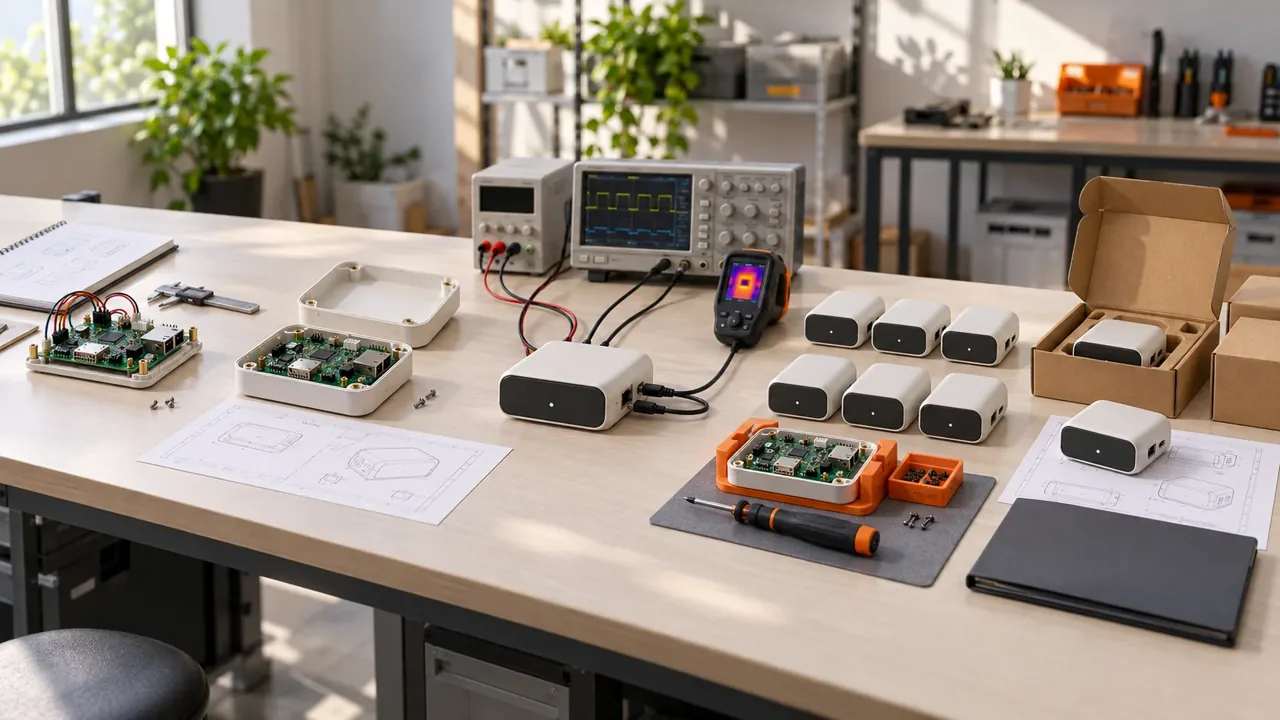
Hardware Prototype to Production in India
From a working prototype to a product your factory can build: DFM, validation, suppliers, pilot builds and handoff, run from our Bangalore studio.
BrahmWorks takes hardware prototypes to production for founders and product teams in India. We run a design-for-manufacture and assembly (DFM/DFA) review, validate the design, prepare tooling and suppliers, build a measured pilot batch, and hand a documented release pack to the factory, whether that is your contract manufacturer or one of our build partners. Engineering is done in-house in our Bangalore studio: mechanical, electronics, firmware and industrial design. We have been building hardware since 2017.
DFM & DFA
Tolerances, materials, assembly sequence, and cost drivers decided before tooling.
Pilot Builds
Engineering samples, EVT/DVT-style loops, and field validation with clear change control.
Production Handoff
Supplier packs, drawings, BOMs, test plans, and manufacturing support that hold up on the line.
A working prototype is not yet a product
A prototype shows that the idea works. Production readiness shows that someone else can build the product again and again, without the original engineer fixing each unit by hand. Most of the work in between is unglamorous: tolerances, assembly sequence, part sourcing, test gates, and drawings a supplier can quote from.
We work with:
- startups building their first hardware product
- teams that have a working prototype but are stuck before production
- companies building EV, IoT, medical-device, agri and industrial hardware
- businesses that want one team for design and manufacturing support
If you are still at the idea or proof-of-concept stage, start with For Founders.
What we will and will not claim
- A pilot is not mass production. It measures whether the intended process can build acceptable units, and we tell you which production assumptions are still unverified.
- A manufacturing run is not a certificate. We design and build with certification requirements in view when they are in the brief.
- Scope is agreed before parts are ordered.
Case study: FireFit
For FireFit, a connected fitness product that uses sensors to digitise workout repetitions, BrahmWorks handled the whole path: design sketches, PCB design and component selection, metal and plastic parts, assembly and manufacturing processes, quality control and the companion app.
In the assembly and manufacturing stage the team applied DFA, DFM and DFR and built the sub-assemblies that led to the first fully built product.
Prototype to production
How we take a prototype to production.
Five steps, each with a clear output, so you decide what to do next with evidence in hand. You do not have to use every step; many teams come to us at the DFM review or the pilot. How long each step takes depends on the product, and we give you a stage-by-stage estimate after a free review call.
Already have a prototype?
Start with a review of what you have.
What happens: if your prototype was built by another team, or in-house, we begin with a design review and integration gap assessment against the performance, reliability and manufacturing needs of a production product.
What you get: prioritised validation and DFM work, and a plan for the next prototype or pilot stage.
Step 1 · DFM/DFA review
Make the design ready to build and assemble.
What happens: we review the prototype against the process that will make it (moulding, sheet metal, CNC or PCB assembly): wall sections, draft, fits and tolerances, fasteners, cable routing, assembly sequence and service access, with mechanical, electronics and enclosure in one review.
What you get: a changed CAD model and a short list of decisions, not a slide saying the design is manufacturable.
Step 2 · Engineering validation
Test the system. Close the gaps.
What happens: we test the integrated product (enclosure, board, firmware and app) against written acceptance criteria: functional and stress testing, plus compliance checks where the brief needs them, in EVT/DVT-style loops with change control. Compliance is product- and market-specific; which certifications and test labs your product needs, we’ll confirm during scoping.
What you get: a validated design revision, test records, and a list of which production assumptions are proven and which are still open.
Step 3 · Tooling and suppliers
Choose the route, brief the suppliers.
What happens: we choose the manufacturing route for your volumes and cost targets and write vendor briefs (process, tolerance callouts, acceptance criteria) for moulders, sheet-metal shops and PCB assemblers. Boards come from our exclusive PCB fab partners, typically 1 to 12 layers. Who manages tooling vendors and who owns the tools for your product, we’ll confirm during scoping.
What you get: a controlled BOM with approved alternates, production drawings, Gerbers and pick-and-place files, and first-article reviews so deviations are decided, not absorbed into the next lot.
Step 4 · Pilot or low-volume build
Build the first real units the way production will.
What happens: we build with a frozen-enough BOM, work instructions, fixtures and test gates. A pilot is often tens to low hundreds of units, sized by risk, process complexity and what you need to learn. We measure first-pass yield, defect causes and assembly time, and trace each failure to design, process or parts.
What you get: assembled units with build records, a yield and defect report, and a clear decision: change the design, or release it for the next volume step.
Step 5 · Production handoff and scale-up
A product. And a way to build it.
What happens: we package the release so a contract manufacturer can quote and build without calling the designer: BOM and approved vendor list, drawings and 3D, the electronics package, assembly and QC gates, packaging notes, and how change requests are handled. Board assembly moves from hand builds to supplier SMT lines as volume grows from tens to thousands.
What you get: a release pack your CM or vendors can run, plus engineering support through first articles and early lots when you need it.
Post Collaboration Insights with BrahmWorks.
Thousands of teams trust Brahmworks to deliver measurable ROI, unlock greater productivity.

BrahmAI
How can I help you today?
Jacob Smith
What is the status of my project?
BrahmAI
Currently in the design phase….
The choice of thousands
Brahmworks is connected to over 8000 vendors across the globe. And has team in China and India.
+8
x
Average team size working on your project to get it market ready.
30
%
Shortened timelines for project milestones, including prototyping, testing and deployment.
Where the work happens
One team in Bangalore, building with your factory or ours.
Bangalore studio, your CM or our partners
Design, engineering and prototype reviews happen at our studio in Bangalore, where electronics, mechanical, firmware and industrial design sit in one team. Boards are built with our exclusive PCB fab partners, by hand for prototypes and early batches and on supplier SMT lines as volume grows. Mechanical parts and final assembly go to suppliers matched to the process and volume, or to your own contract manufacturer. We work with teams across India and beyond. When you need engineering on the floor, we stay through first articles and join line calls; on-site support at locations outside Bangalore is something we’ll confirm during scoping.
Your CM or ours
You do not have to switch manufacturers. Mark-ups from your CM go back into the model and the BOM. If you do not have a CM, we can build with our fab and assembly partners.
Timelines
Timelines depend on the product. As a guide for complete product development, simple products typically take 3–6 months and complex designs a year or more (For Founders). Taking an existing prototype to production covers part of that path. After a free review call, we give you a scoped estimate.
Costs
Cost depends on the design changes needed, tooling, suppliers, certification and pilot volume. After a free consultation with a lead engineer, we send a customised estimate that lists the services needed. Scope is agreed before parts are ordered; the commercial model for your project, we’ll confirm during scoping.
Related paths on BrahmWorks
DFM & DFA — manufacturability and assembly review before tooling.
Turnkey manufacturing — pilot, PCB and CM handoff on one path.
Pilot & low-volume production — measured builds before a volume buy.
Electronics / PCB manufacturing — fab, assembly, programming and test.
Supplier & CM handoff — release packs your CM can build from.
Mechanical design — enclosures, thermal, mechanisms, DFM.
Electronics design — schematics, PCB layout and firmware.
EV product design — e-mobility hardware that is built to manufacture.
Product design company Bangalore — end-to-end hardware team.
For Founders — founder worksheets and starting points.
Everything you need to know
How long does prototype to production take in India?
It depends on the product: how close your prototype is to production intent, how many custom parts need tooling, and which certifications apply. As a guide for complete product development, simple products typically take 3–6 months and complex designs a year or more. Taking an existing prototype to production covers part of that path. After a free review call, we give you a scoped, stage-by-stage estimate.
How much does it cost to take a hardware prototype to production?
It depends on the product: the design changes needed, tooling, the number of suppliers, certification and pilot volume. After a free consultation with a lead engineer, we send a customised estimate that lists the services needed.
When should we involve BrahmWorks in NPI?
Ideally before hard tooling — once the architecture is clear but parts and assemblies can still change. We also join mid-pilot when yield, cost, or supplier issues are blocking release.
Can you take over an existing prototype built by another team?
Yes. We start with a design review and integration gap assessment of your current prototype, then prioritise the validation and DFM work and plan the next prototype or pilot stage.
Do you only do design, or manufacturing support too?
Both. We design for manufacture and stay through pilot builds, vendor handoff, and line issues when you need engineering on the floor.
Do you manufacture products yourselves, or use partners?
Both, depending on the type of product, quantity and materials. We can run or support pilot and low-volume builds, and we manufacture PCBs with exclusive fab partners using SMT and hand assembly. For some products we work with your CM or our supplier network. Scope is agreed before parts are ordered.
Can you work with our existing CM or suppliers?
Yes. We package drawings, BOMs, and process notes so your contract manufacturer and vendors can build without tribal knowledge stuck in the studio.
What is the minimum volume you work with?
We don’t publish a minimum order quantity. A pilot is often tens to low hundreds of units, sized by risk, process complexity and what you need to learn. Board assembly moves from hand builds to supplier SMT lines as volume grows from tens to thousands. If a minimum applies to your production run, we’ll confirm it during scoping.
Is this only for EV hardware?
No. The same NPI path applies across EV, IoT, medical-adjacent devices, agri hardware, and special-purpose machines — EV is a strong vertical for us, not the only one.
Will you sign an NDA, and who owns the IP?
Yes. We will share, or you can share, a two-way NDA before we discuss your project. When you develop a product with BrahmWorks, you retain 100% of your company equity and IP throughout the process; we do not accept equity or IP in exchange for our product development services.
Get Quote Now
Get a customised estimate for Product Development.
For more information about our tech stack, visit here.
Hardware Design Mandate
Hardware Design Mandate1:1 Meeting Setup
Schedule a one-on-one meeting with our Engineering team for personalised assistance and insights.
Schedule 1:1 Meeting
Schedule 1:1 MeetingReady to take the next step in your product development journey?
Connect
Contact Us
© 2026. Built with ♥️ in Bengaluru.